

VÉRA
VÉRA is a smart mirror designed to reduce the cognitive load of daily outfit decisions
VÉRA supports faster outfit decisions by working within an existing habit: standing in front of a mirror. Instead of adding more browsing, filters, or setup steps, it provides a small set of context-aware suggestions and learns through lightweight feedback.
Role: UI/UX Designer · Research, interaction design, prototyping, usability testing
Scope: Smart mirror interface · 8 weeks · 2 designers
Focus: Choice reduction · Context-aware recommendation · Spatial interaction
The project focused on the smart mirror as the primary touchpoint because it aligned with users’ existing dressing routine.
Outfit Stress Is Context-Driven
Users struggle less with owning clothes, and more with deciding what fits the moment
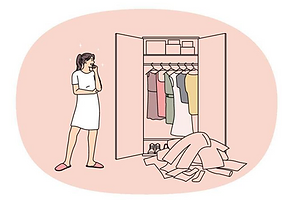
Choosing what to wear is rarely about lacking clothes. Most people struggle when outfit decisions are made under time pressure, emotional stress, or unexpected context changes.
Existing solutions often respond by showing more options or promoting trends. This project explored a different question:
How might we reduce the mental effort of making an outfit decision using what users already own?
Possible User Circumstances & Unexpected Situations

Research & Key Insights
Survey and exploratory research showed that outfit stress was driven by changing context, not just clothing availability.
Key insight clusters:
1. Context shifts
Weather, events, travel, and mood change what “appropriate” means.
2. Decision fatigue
Users want guidance, but resist heavy setup or constant control.
3. Wardrobe awareness
Users want help using what they already own before buying more.
Design implication: VÉRA should act as a decision aid, not a shopping or browsing tool.
74%
want AI recommendation for daily outfits
61%
Want automatically record the clothes in th closet
39%
want reminder of washing/dry cloth
26%
want sharing outfits to friends/ let friends choose
These findings pushed the design toward low-friction recommendations, automatic wardrobe awareness, and optional user control.
Why the Mirror Became the Core Touchpoint
We chose the option that reduced habit change, not the option that added more hardware behavior
1

Smart Mirror
2

Rotating Rack
Two concepts were explored: a rotating rack and a smart mirror.
The rotating rack made clothing more visible, but introduced mechanical complexity and required users to change how they access their wardrobe.
The smart mirror fit into an existing routine. Users already stand in front of a mirror when evaluating outfits, so guidance could appear at the moment of decision without adding a new behavior.
We evaluated the concepts through three criteria:
-
Behavioral friction — Does it fit an existing habit?
-
Implementation complexity — Does it require heavy mechanical change?
-
Feedback speed — Can users react quickly and help the system learn?
The smart mirror won because it reduced decision effort without changing the dressing routine.
Core Interaction Model: Suggest, React, Learn
VÉRA is designed as a decision aid, not a browsing tool
Stand In Front Of Mirror
Context Detected
Outfit Suggestions
User Reacts
(like / adjust)
System
Learns
VÉRA avoids asking users to search, filter, or define preferences upfront.
A session starts when the user stands in front of the mirror. The system detects context, presents a small set of relevant outfits, and learns from lightweight reactions such as likes, dislikes, skips, and adjustments.
The goal is not to automate taste, but to reduce the effort of getting started.
Key Design Decisions
Several product decisions guided the interface and interaction model

Decision 1
Limit the first choice set
Each session surfaces only a small number of outfit options. This keeps users in comparison mode rather than browsing mode, reducing decision fatigue at the moment of choice.
Design impact: The mirror becomes a shortcut to decision-making, not another closet to scroll through.
Decision 2
Learn through interaction, not setup
Instead of asking users to define preferences upfront, VÉRA learns through in-flow actions: likes, dislikes, skips, and item swaps.
Design impact: Personalization starts without a long onboarding process.
Decision 3
Context before aesthetics
Occasion, weather, and mood are considered before visual variation, so suggestions feel useful rather than decorative.
Design impact: Recommendations are evaluated by relevance first, not style variety alone.


Interface Outcomes
How the product decisions translate into the mirror experience
Home & Outfit Suggestion
The home view prioritizes outfit suggestions over system controls. Key actions stay close to the outfit area to reduce hesitation during decision-making.


Virtual Try-On
Context previews were designed to help users imagine outfit fit across travel, weather, or event settings.


Learning Through Interaction
Feedback is collected directly through in-flow actions, such as likes, dislikes, and skips.
These signals influence future suggestions without requiring users to complete setup steps or explicitly define preferences.
Validation: Testing the Mirror
Low-fidelity physical prototypes helped test spatial behavior before high-fidelity UI


Early testing used paper prototypes to simulate the mirror experience at 1:1 scale.
The concept was easy to understand, but users showed hesitation after an outfit appeared. The next action was not always clear, especially when key controls were visually separated from the outfit.
Iteration: Interaction cues and key actions were moved closer to the outfit area, reducing uncertainty during decision-making.
Findings
What worked:
Users understood the value of AI-assisted outfit suggestions.
What caused hesitation:
Some users were unsure what to do after a suggestion appeared.
What changed:
Action cues were clarified and placed closer to the outfit area.
Spatial Accessibility:
Designing for Different Heights
A mirror interface must adapt to physical reach, not only screen size

Testing revealed that mirror interactions are shaped by height, distance, and reach. Unlike mobile interfaces, the interaction area is tied to the user’s body position.
This led to a dynamic vertical layout strategy: primary controls shift to remain visible and reachable for users at different heights.
Design impact: The mirror experience becomes more inclusive without requiring manual adjustment.
Reflection & Next Steps
This project reinforced that reducing decision effort is different from increasing choice.
The strongest outfit recommendation system is not the one that shows the most options, but the one that helps users act with less hesitation.
Future iterations would explore clearer explanations behind recommendations, privacy comfort around in-home camera systems, and on-device processing for sensitive mirror interactions.
The key product lesson: smart systems should support decision-making without taking control away from users.
What's More
Previous Project: SeeMuseum

Next Project: Trekka
