


Trekka
Trekka helps shoppers understand shoe fit before purchase by turning mobile 3D foot scans into explainable recommendations.
Instead of relying only on size labels or reviews, users can compare their foot profile with product-specific fit characteristics and make more confident purchase decisions.
Fit-confidence tool for online shoe shopping


Role: Product Designer
Scope: Research, mobile onboarding, foot-scanning flow, recommendation UX
Team: 4 UI/UX Designers
Timeline: 03/2023–05/2023
Focus: Fit confidence · Explainable recommendation · Return-risk reduction
Problem & Constrains
Fit Uncertainty Drives Return Behavior
Fit uncertainty drives return behavior.
Online shoe shoppers often cannot tell whether a product will match their actual foot shape. When confidence is low, they may abandon the purchase, order multiple sizes, or return what does not fit.
Trekka focuses on reducing uncertainty before purchase by making fit more measurable, visible, and explainable.

Returns are expensive for both customers and retailers.
63%-72% of Adults do not wear shoes that accommodate their foot dimensions
-National Library of Medicine
Project Concept
From Shoe Size to Fit Profile
Shoe size alone does not explain fit. Two people with the same size may have different width, arch height, and length proportions.
Trekka uses mobile scanning to create a reusable fit profile and match it against shoe-level characteristics.
The product turns fit from a guess into a comparison.


Finding the Highest-Impact Moment
Trekka focuses on pre-purchase fit evaluation, where uncertainty is highest and return risk begins
Research Evidence
Journey Map
(for both users and Trekka’s side)


Journey mapping showed that fit uncertainty peaks during evaluation and selection.
Users are not only asking “Which shoe do I like?” They are asking “Will this actually fit me?”

Scope Decision

Trekka focuses on the pre-purchase evaluation moment rather than the entire shoe-shopping journey.
This narrowed the product down to three core actions:
Scan the foot → Explain the match → Recommend shoes
Product Architecture
Scan → Explain → Recommend → Learn


To keep the first-time experience focused, I structured the product around one core loop:
Scan foot → Generate fit profile → Explain match → Recommend shoes → Collect feedback
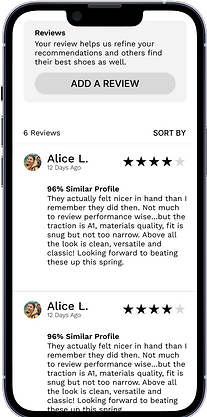
Secondary features such as surveys, reviews, notifications, and settings were placed outside the first-use flow to reduce setup friction.
Design principle: minimal setup, maximum fit confidence.
Recommendation Loop
Effortless scanning for the perfect fit every time

Scan
Find your perfect running shoe match without the hassle of trying them all on

Match
Get personalized shoe recommendations without ever leaving your couch!

Explain
Learns and adapts based on your feedback, ensuring greater accuracy with every use
Learn
Core Experience
Onboarding Sequence

Users fill out basic information, scan their feet, and are presented with some basic recommendations based on their results.
Guided Foot Scanning

The scanning flow is the highest-friction step in the product, so the interface breaks it into clear, guided actions.
Key design choices:
-
Step-by-step framing
-
Users scan one angle at a time instead of being asked to understand the full scanning logic upfront.
-
-
Real-time alignment feedback
-
Foot outlines, progress states, and success confirmation help users know whether they are doing it correctly.
-
-
Privacy statement before scanning
-
Users see why scan data is needed before providing sensitive body information.
-
Building Confidence Through Explainable Fit
Showing why a recommendation fits, not just how much it matches.
A match percentage alone can feel like a black box. Trekka makes the recommendation more transparent by showing how the user’s fit profile compares with product characteristics across width, arch height, and length.
Design impact: Users can understand the reason behind a recommendation before deciding whether to buy.


Take your right steps with the right shoe recommendations.
What's More
Previous Project: VÉRA

Next Project: Neura
